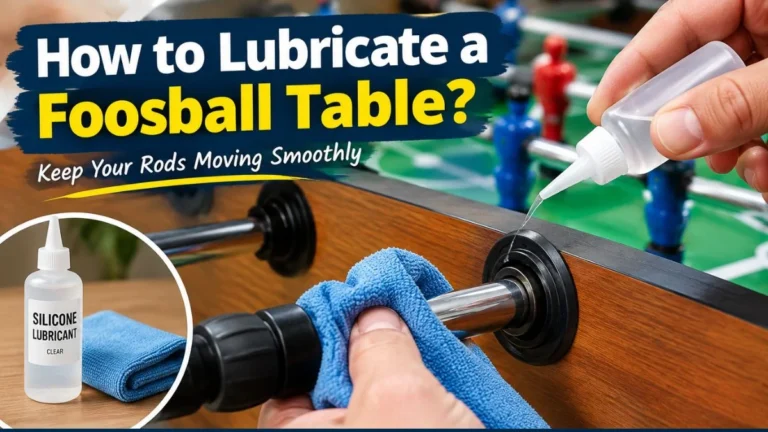
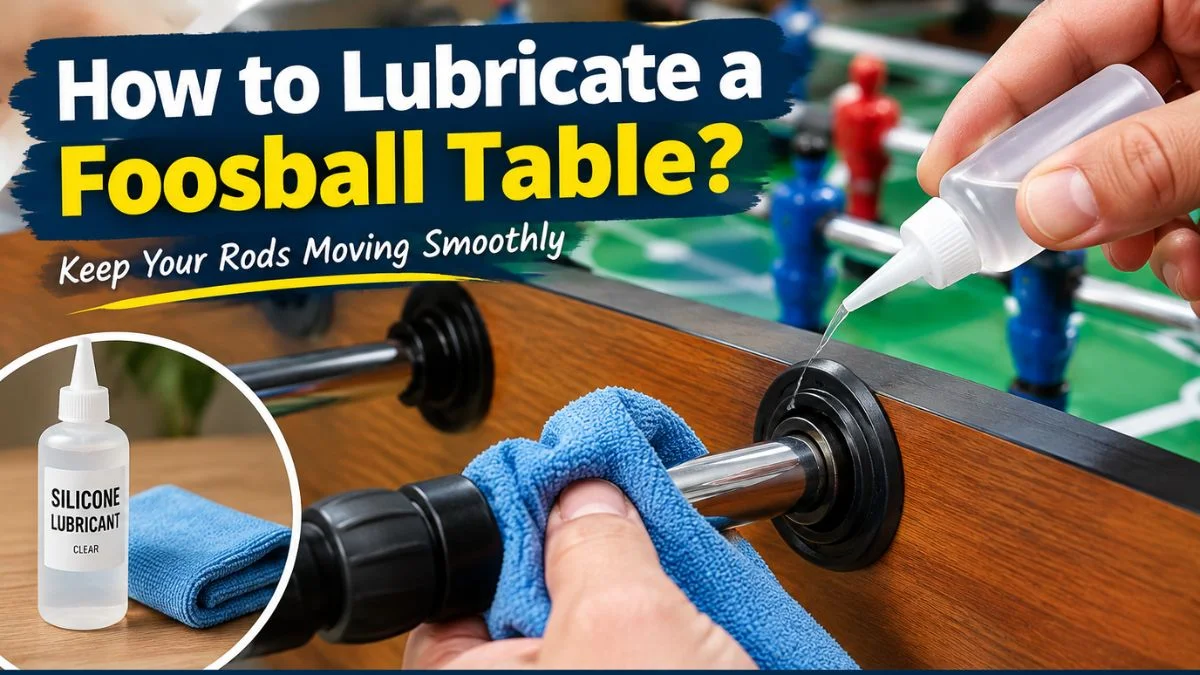
How to Lubricate a Foosball Table?
If your foosball rods are starting to feel stiff, noisy, or difficult to spin, the first thing I recommend checking is the lubrication around the rod bearings. A properly lubricated foosball table should let the rods move smoothly without requiring much effort.
I’ve lubricated plenty of foosball tables, and one mistake I see quite often is using far too much lubricant. You don’t need to soak the rods or bearings. A small amount of the right silicone lubricant is usually enough.
In this guide, I’ll show you how I lubricate foosball rods, what lubricant I use, how much to apply, and what I do when the bearings are particularly dirty.
What Do You Need to Lubricate a Foosball Table?
You don’t need a complicated collection of tools. For normal foosball table maintenance, I keep it simple:
- Silicone-based foosball rod lubricant
- A clean cloth or rag
- A little patience
Product: Silicone Foosball Lubricant
I use a clear silicone fluid for lubricating the rods and bearings. Silicone lubricant is commonly used for foosball rod maintenance because it helps the rods move smoothly without leaving the type of heavy, sticky residue you don’t want around the playing surface.
When choosing a lubricant, make sure it is suitable for foosball rods and bearings. I would avoid grabbing just any household oil from the garage. The wrong lubricant can attract dirt, affect the playing characteristics of the table, or create a mess.
My advice: If you are buying lubricant specifically for your foosball table, look for a quality silicone-based foosball rod lubricant rather than a general-purpose oil.
How to Lubricate Foosball Rods
The actual process is pretty straightforward. The important part is controlling the amount of lubricant you use.
1. Pull the Rod Toward You
Start with the rod you want to lubricate and pull it all the way toward you.
This gives you better access to the area around the bearing and lets you work the lubricant into the bearing more effectively.
I like to work on one rod at a time rather than putting lubricant on every rod first.
2. Wipe the Rod and Bearing Area
Before adding any lubricant, take a clean cloth or rag and wipe the rod.
This step is easy to skip, but I don’t recommend doing that.
Dirt and grime can build up on the rod over time, and you don’t want to mix that dirt with fresh lubricant and push it straight into the bearing.
Give the rod a good wipe, particularly around the area that passes through the bearing.
3. Apply a Small Amount of Silicone Lubricant
Now add a small amount of silicone lubricant along the top of the rod near the bearing.
You don’t need much.
I usually put down a small stream rather than pouring a large amount onto the rod. The goal is to give the bearing enough lubricant to work smoothly-not to cover the entire rod in silicone.
4. Rotate the Rod
Once the lubricant is on the rod, slowly spin the rod.
As you rotate it, the silicone works its way around the bearing.
This is also where you’ll sometimes see dirt or crud coming out of the bearing.
That’s actually useful information because it tells you that the lubricant is helping loosen and move some of the dirt that has accumulated inside.
5. Wipe Away the Dirt and Excess Lubricant
After working the rod through the bearing, take your cloth and wipe the rod clean.
Don’t leave a thick layer of lubricant sitting on the rod.
The goal is a smoothly lubricated bearing, not a greasy foosball table.
I also pay close attention to keeping excess lubricant away from the playing surface. You don’t want silicone getting onto the table because it can change how the ball behaves and make the surface unnecessarily slick.
6. Repeat on Every Rod
Once one rod is clean and lubricated, move on to the next one.
Pull the rod toward you, wipe it, apply a small amount of silicone lubricant, rotate the rod, and wipe away the excess.
Then repeat the same process until you’ve lubricated all of the rods.
How Much Foosball Rod Lubricant Should You Use?
This is one area where I think less is better.
You don’t need to flood the bearing with lubricant.
A small amount is enough to coat the area and allow the rod to rotate smoothly. If you’re spraying or pouring lubricant everywhere, you’re using too much.
There are two problems with excessive lubricant.
First, it can make a mess. If silicone gets onto the playing surface, you can end up changing the way the ball rolls.
Second, excess lubricant can collect dirt and grime instead of simply helping the bearing stay clean and smooth.
So when you’re unsure, start with a small amount and add more only if necessary.
Should You Spin the Foosball Rod Fast?
I wouldn’t.
Once you’ve applied the lubricant, rotate the rod enough to distribute the silicone through the bearing. You don’t need to spin the rod extremely fast.
In fact, spinning it too aggressively can send lubricant flying onto your table.
I’ve found that controlled rotation works just fine. You’re trying to work the lubricant through the bearing-not turn the rod into a high-speed sprinkler.
What If Dirt Comes Out of the Bearing?
Don’t be surprised if you see some dirt or crud come out when you lubricate an older or heavily used table.
That’s one reason I like wiping the rod before and after lubrication.
If the bearing is only moderately dirty, the lubrication process and wiping can remove a good amount of the buildup.
However, if the bearing is really dirty, lubrication alone may not be enough.
Product: When You Need More Than Lubricant
If you have a heavily contaminated bearing, I would stop trying to solve the problem simply by adding more lubricant.
In that situation, the bearing may need to be removed and cleaned properly. Depending on the table and bearing design, you may be able to disassemble the bearing and clean it with soap and water before drying it thoroughly and lubricating it again.
I wouldn’t keep pouring lubricant into a badly contaminated bearing. More lubricant isn’t a substitute for cleaning.
How Often Should You Lubricate a Foosball Table?
There isn’t one universal schedule that works for every table.
How often you need to lubricate the rods depends on how frequently you play, how clean the table is, the type of bearings your table uses, and how the rods feel during play.
Instead of blindly following a calendar, I recommend paying attention to the rods.
If they start feeling noticeably less smooth, become harder to rotate, or start making more noise than usual, that’s a good indication that it’s time to inspect and lubricate them.
For a table that gets heavy use, regular inspection is particularly important.
What I Don’t Recommend Using on Foosball Rods
One of the biggest mistakes is treating foosball rods like any other piece of metal hardware.
I wouldn’t automatically reach for household oil, cooking oil, grease, or whatever lubricant happens to be sitting in your toolbox.
The lubricant has to work with the rod and bearing without creating unnecessary residue or affecting the playing surface.
Product: Use a Foosball-Specific Silicone Lubricant
If you’re buying a lubricant for your foosball table, I’d choose a product specifically intended for foosball rods and bearings whenever possible.
The important thing isn’t simply finding something that’s “slippery.” You want something that provides smooth rod movement while being appropriate for the table’s bearing system.
My Simple Foosball Lubrication Routine
If you want to keep the process simple, this is the routine I use:
- Pull the rod toward you.
- Wipe the rod with a clean cloth.
- Apply a small amount of silicone lubricant near the bearing.
- Rotate the rod to distribute the lubricant.
- Watch for dirt or crud coming out.
- Wipe the rod clean.
- Make sure no excess lubricant reaches the playing surface.
- Repeat the process for every rod.
That’s really all there is to it.
You don’t need to overcomplicate foosball table lubrication. Clean the rod first, use a small amount of silicone lubricant, rotate the rod to work it through the bearing, and wipe away the excess.
If a bearing is extremely dirty, clean the bearing properly instead of continuing to add lubricant.
I’ve found that regular, simple maintenance makes a noticeable difference in how a foosball table feels.
The key is not how much lubricant you use. It’s using the right lubricant and applying the right amount.
A few minutes with a cloth and a small amount of silicone fluid can keep the rods moving smoothly and make the table much more enjoyable to play.
And remember my biggest tip: don’t get carried away with the lubricant. You want smooth rods-not a slippery playing surface.